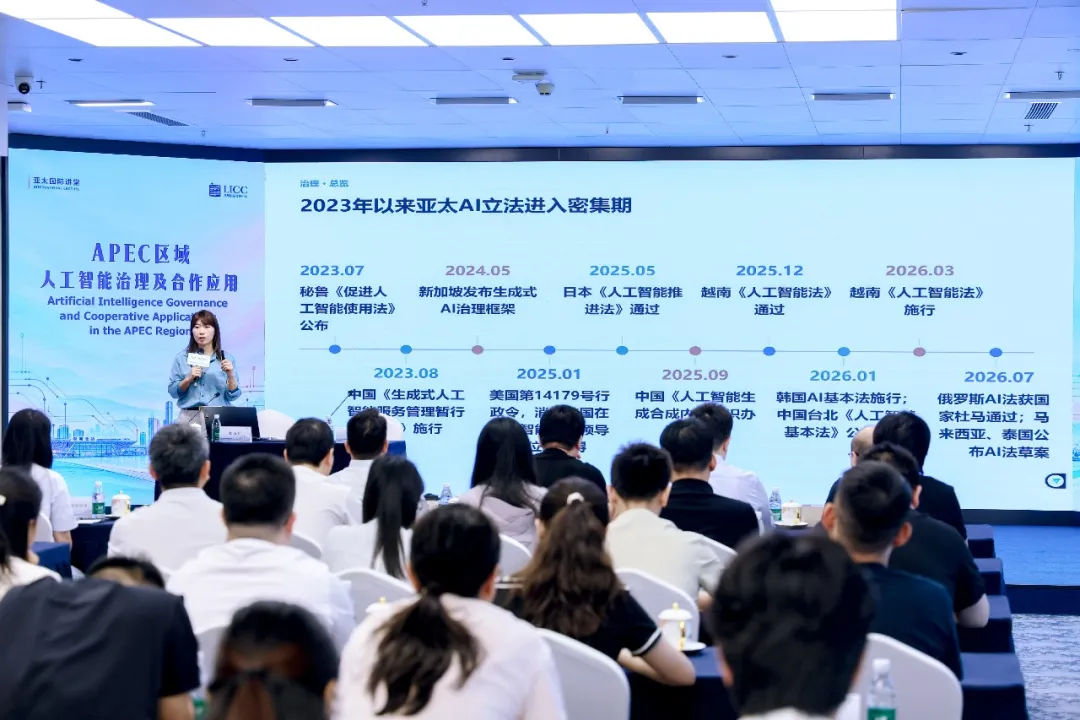
Participants attend the sixth APEC International Lecture at the Shenzhen (Longhua) International Cooperation Center (LICC) on Oct. 27. The lecture explored AI governance across APEC economies and opportunities for industrial applications in Shenzhen. Photos courtesy of LICC
The sixth “APEC International Lecture,” held at the Shenzhen (Longhua) International Cooperation Center (LICC) on Oct. 27, offered local officials a comprehensive look at how APEC economies are regulating artificial intelligence, and how Shenzhen can capitalize on the region’s digital transformation wave.
Zhang Jingjia, an associate research fellow at Nankai University’s APEC Study Center, gave the lecture.
A golden era of AI legislation
Zhang noted that 2025 and 2026 have seen a surge in AI legislation across the Asia-Pacific. Six APEC economies have enacted comprehensive AI laws. These divergent approaches, legislation-based, market-led, and framework-based, make a single unified standard unlikely within APEC.
“The charm of APEC lies in its inclusive mechanism, which helps economies find common ground despite their differences,” she stressed.
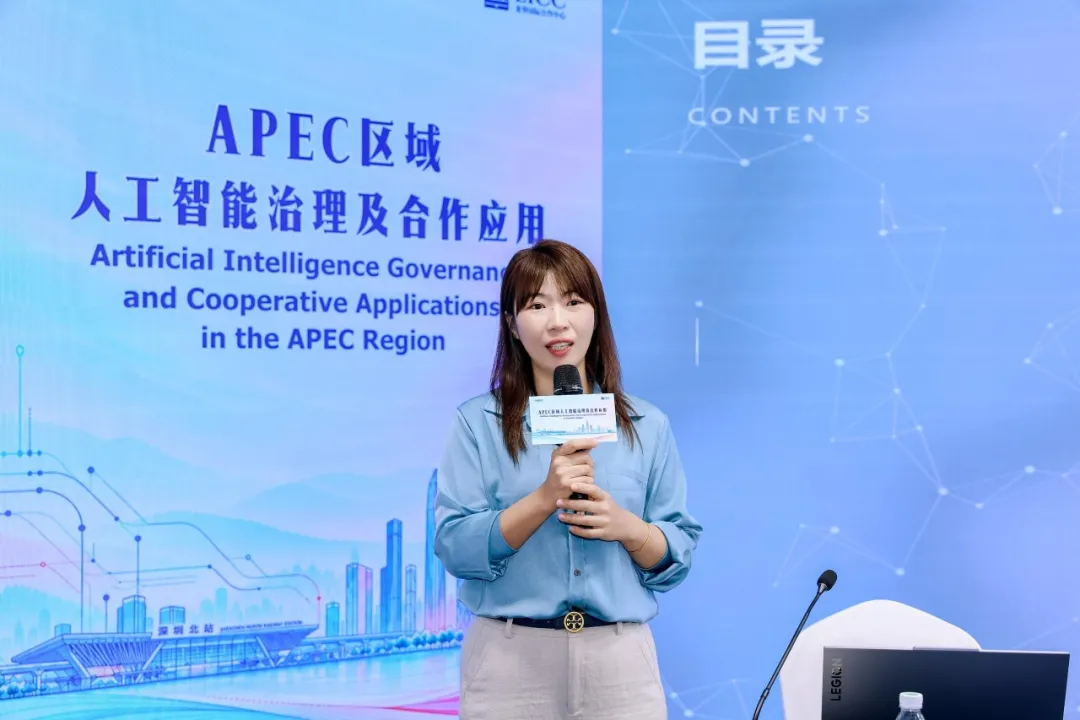
Zhang Jingjia, an associate research fellow at Nankai University’s APEC Study Center, delivers a lecture on AI governance and cooperation across the Asia-Pacific region at the LICC on Oct. 27.
Three pathways for traditional industries
Drawing on a joint survey on the use of AI i traditional industries, the lecture outlined three main approaches: embedding AI into existing software (lowest barrier to entry for SMEs), building custom solutions for specific business problems, and partnering with specialized technology providers.
For example, UPS’ AI-powered customs system raised clearance rates to 99%, with 97% of shipments cleared on the same day. New Zealand’s eShepherd uses AI-enabled virtual fencing in more than 14 economies.
Shenzhen offers another notable example. SmartMore, a local AI firm, has enabled manufacturers to train models locally without data leaving their factories, reducing defect miss rates to 0.3% and cutting maintenance costs by 20%.
Shenzhen’s opportunity
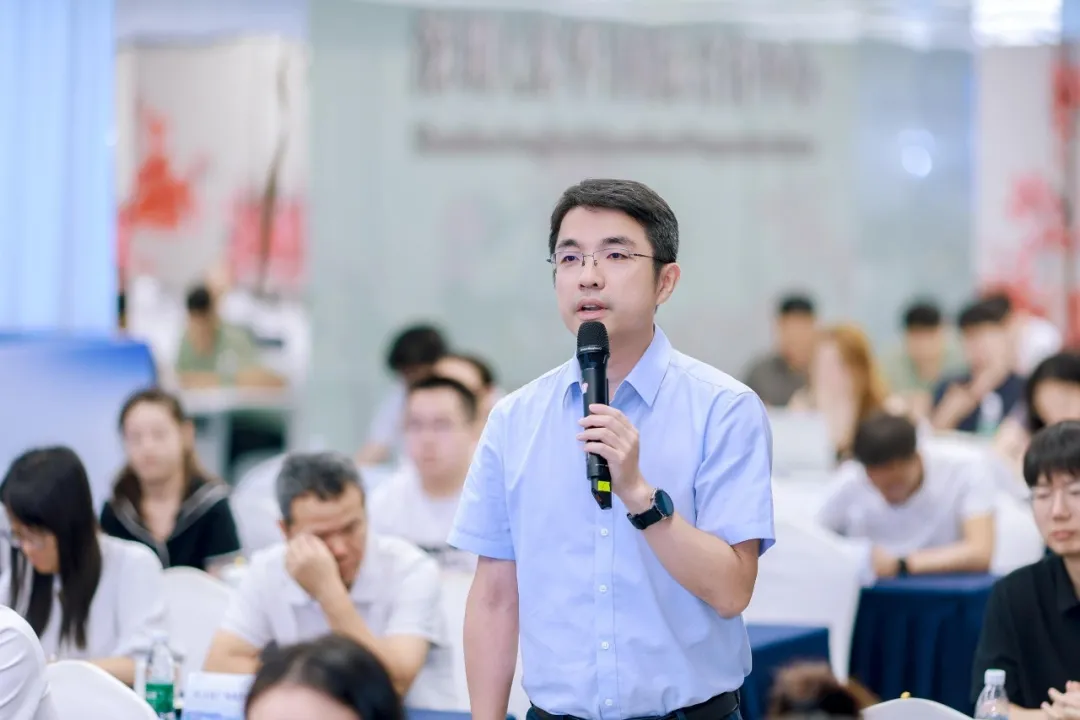
A participant speaks during an interactive session at the sixth APEC International Lecture at the LICC on Oct. 27.
The key task ahead is to empower traditional industries and SMEs.
Longhua, whose core digital economy industries generated more than 610 billion yuan (US$91.50 billion) in output in 2025, with their value-added accounting for more than 35% of GDP, has a major advantage in its real-world applications in intelligent manufacturing, connected vehicles and robotics.
Shenzhen has more than 2,600 AI enterprises above designated size, with core AI industry revenue of about 220 billion yuan in 2025. The city, which has ranked first nationwide in foreign trade for two consecutive years, is well positioned to capitalize on the international exposure offered by the upcoming APEC meetings, Zhang concluded.
Zhang also recommended translating APEC consensus documents into compliance guidelines for enterprises expanding overseas, citing the Guangdong-Hong Kong-Macau Greater Bay Area’s cross-border data standard contract as a model for cooperation that starts with targeted initiatives in clearly defined areas before expanding through pilot programs.
With the APEC CEO Summit and Economic Leaders’ Meeting coming to Shenzhen in November, AI cooperation is expected to feature prominently in the meetings' final outcome documents.
Without written authorization from Longhua District People's Government,the content of the site shall not be republished or used in any form
Technical support hotline: 0755-23332038






