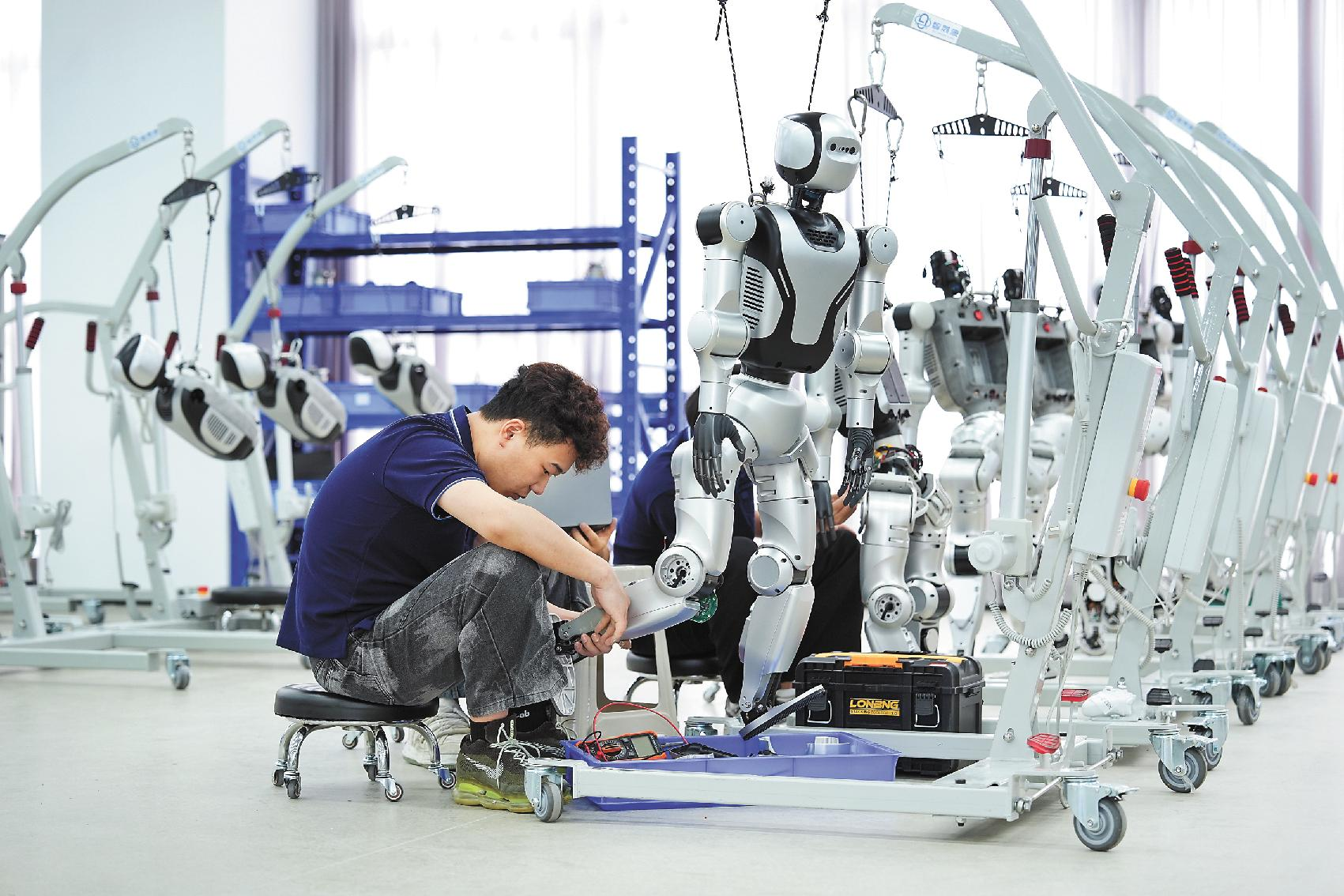
Engineers adjust and test humanoid robots on a pilot production line at Leju Robotics in Longhua on April 12. Photos by Chen Jianhua
A pilot production line for humanoid robots has begun operation in Shenzhen’s Longhua District, as Chinese firms move to bridge the gap between lab prototypes and mass manufacturing in a fast-developing sector.
The facility, run by Leju Robotics, is designed to test manufacturing processes, stabilize quality and reduce costs before large-scale production. Industry players have struggled with inconsistent output and high expenses as they push humanoid robots from research into real-world use.
Leju said the Longhua line will handle small-batch trial production of its ROBAN 2 model while validating processes under three priorities: flexibility, standardization and digitalization. A modular assembly system and independent testing stations cover the full chain from process verification to pre-mass production.
A digital Manufacturing Execution System (MES) tracks assembly data throughout, allowing defects to be traced and processes to be replicated. The company said ROBAN 2 has undergone more than 170 process improvements across two major iterations.
“Pilot testing is the checkpoint between R&D and mass production,” said Cao Yu, assistant vice president of Leju Robotics. “It’s where you prove that a product can be made reliably, at scale and at a reasonable cost.”
The Longhua line has a cycle time of up to 120 minutes per unit and a planned annual capacity of 500-1,000 units. Its immediate task is to establish standardized workflows for future expansion.
Leju has set up a regional manufacturing structure that keeps research and pilot testing in Shenzhen while shifting large-scale production to Foshan, where it is working with Dongfang Precision on an automated line designed for annual output exceeding 10,000 units.
The company said its robots have already been delivered in batches for use in research, education and some commercial and industrial scenarios. It is now targeting broader deployment, including reception services, guided tours and inspection tasks, as well as material-handling functions in factories.

Humanoid robots undergo movement tests at a pilot production facility operated by Leju Robotics in Longhua District, Shenzhen.
The launch reflects broader policy and industry momentum in southern China. National and provincial plans have identified embodied artificial intelligence — systems that combine software with physical machines — as a strategic sector, with a focus on building pilot testing platforms and smart factories.
Guangdong, China’s manufacturing hub, hosts more than 160,000 robotics-related firms and has built a full supply chain from components to finished machines. Output of both industrial and service robots ranks first nationwide, according to official data.
Rising demand is also driving investment. Morgan Stanley estimates China’s humanoid robot shipments could reach 28,000 units in 2026, with the global market potentially exceeding US$5 trillion by 2050.
Against that backdrop, companies like Leju are racing to turn prototypes into scalable products. The Longhua pilot line, the company said, is intended to “set the standards” before humanoid robots move into wider industrial and consumer use.
Without written authorization from Longhua District People's Government,the content of the site shall not be republished or used in any form
Technical support hotline: 0755-23332038






