Longhua District is set to play a defining role in Shenzhen’s next phase of growth under a newly approved spatial master plan extending to 2035 and beyond.
The blueprint positions Longhua as a central service hub, a transport gateway and a digital economy frontrunner, while outlining a clear path toward becoming a globally influential urban core driven by innovation, advanced manufacturing and cultural vitality.
From industrial base to digital urban core

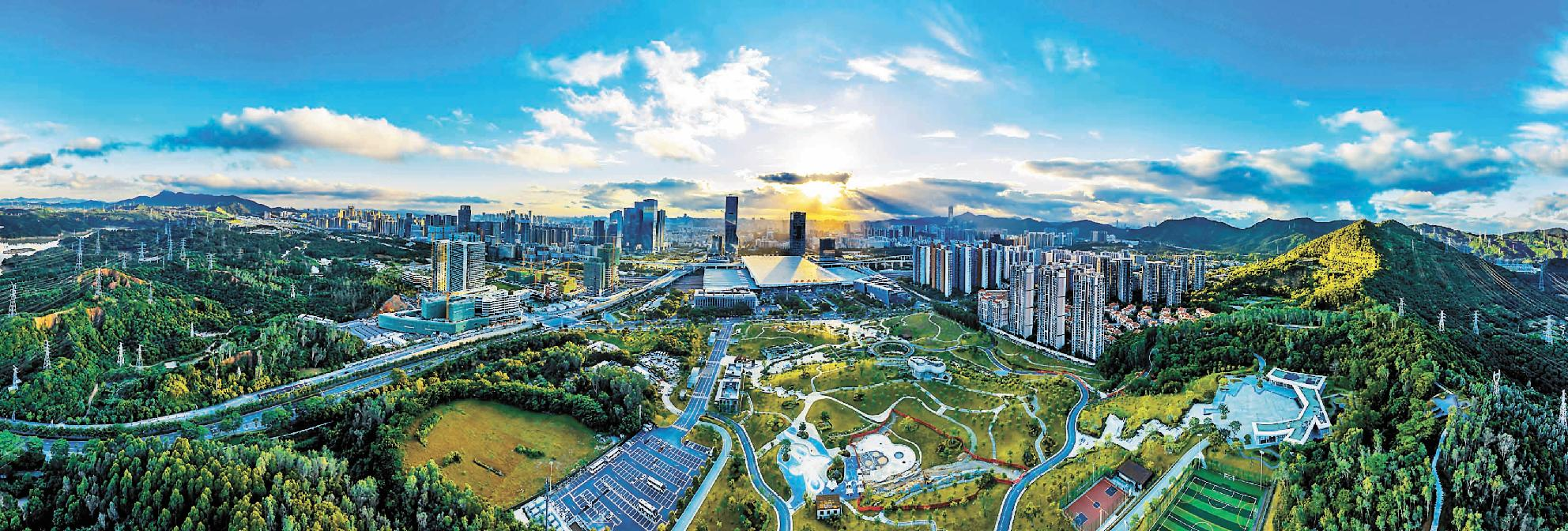
An aerial view of Longhua. Chen Jianhua
At the heart of the plan is a shift in Longhua’s role — from a manufacturing stronghold to a high-density, high-quality urban center powered by the digital economy.
By 2035, the district aims to establish itself as a globally competitive digital economy hub, supporting world-class industrial clusters and contributing to China’s broader digital transformation. Looking further ahead to 2050, Longhua is envisioned as a model of modern urban development, aligned with leading global bay areas and closely integrated with Hong Kong in innovation and cross-border collaboration.
Rather than pursuing outward expansion, the strategy emphasizes intensive, coordinated development, aligning space, industry and infrastructure to maximize efficiency and long-term competitiveness.
Seven zones shaping the future city
The blueprint is anchored by seven key zones — each designed with a distinct identity and function, together forming a cohesive urban and industrial ecosystem:
Meilin Checkpoint area — digital gateway of the Guangdong-Hong Kong-Macao Greater Bay Area
Envisioned as a leading digital economy cluster, the area will host headquarters functions, innovation platforms and advanced logistics. It will focus on technology commercialization and pilot-scale testing, while integrating residential communities and ecological resources to form a high-quality innovation hub linking Shenzhen’s urban core with Longhua.

A computer-generated image of the future Meilin Checkpoint area.
Luhu central area — civic, innovation and low-carbon center
Combining administrative, technological, cultural and lifestyle functions, Luhu will serve as a major public and innovation center in northern Shenzhen. With a focus on dual-carbon development and high-end medical devices, it will also strengthen collaboration with neighboring Dongguan, forming a regional innovation engine supported by landmark cultural facilities and a central urban vitality corridor.

A computer-generated image of the future Luhu central area.
Central axis — international business and headquarters corridor
Designed as Longhua’s urban spine, the central axis will concentrate headquarters economy, financial services and high-end professional services. Positioned as an “international reception hall,” it aims to attract global enterprises, foster innovation ecosystems and serve as a key platform for cross-regional collaboration with Xili Science City, the Hetao cooperation zone and Hong Kong.
A computer-generated image of the future central axis.
Jiulongshan digital city — intelligent manufacturing and AI hub
Focusing on the integration of industry, academia and research, this zone will drive intelligent manufacturing and artificial intelligence development. By clustering industrial land and innovation resources, it aims to accelerate the upgrading of traditional manufacturing while building a world-class AI industry hub and a model “production–living–ecology” integrated innovation city.

A computer-generated image of the future Jiulongshan digital city.
Longhua Super Commercial Area — future consumption destination
Positioned as a city-level commercial core, this area will redefine urban consumption through a multi-layered spatial model integrating elevated walkways, ground-level retail and underground transport. It will combine smart retail, cultural and entertainment experiences, and family-oriented consumption scenarios to create a next-generation commercial ecosystem.
Dalang fashion town — global fashion innovation hub

A computer-generated image of the future Dalang fashion town.
Building on its established textile and apparel base, Dalang will evolve into a globally recognized fashion center driven by original design. The area will attract international designers and brands, promote the integration of technology and fashion, and host major global fashion events, forming a full-spectrum ecosystem spanning design, production and consumption.
Guanlan cultural town — digital culture and heritage gateway
Blending tradition with innovation, Guanlan will focus on cultural heritage, creative industries and leisure tourism. Through digital empowerment of cultural assets such as printmaking and rosewood crafts, the area aims to become an international showcase for Chinese culture and a new hub for cultural exchange and creative industries.

A computer-generated image of the future Guanlan cultural town.
A livable, connected and resilient district
Together, these seven zones define Longhua’s transition into a digitally driven urban core at the heart of Shenzhen’s “south–north expansion” strategy.
For investors and global businesses, the district offers a compelling combination of industrial depth, strategic location and forward-looking planning. For talent, it presents a city environment where innovation, lifestyle and sustainability are increasingly integrated.
Without written authorization from Longhua District People's Government,the content of the site shall not be republished or used in any form
Technical support hotline: 0755-23332038






