Construction has begun on a large-scale medical device industrial hub in Longhua District, marking a new step in Shenzhen’s efforts to expand its high-end medical technology sector.
Located in Guanhu Subdistrict, the project — part of a planned international medical device cluster — broke ground on its first land parcel in March, moving into the construction phase. The site is designed to integrate research, testing, manufacturing and real-world application.
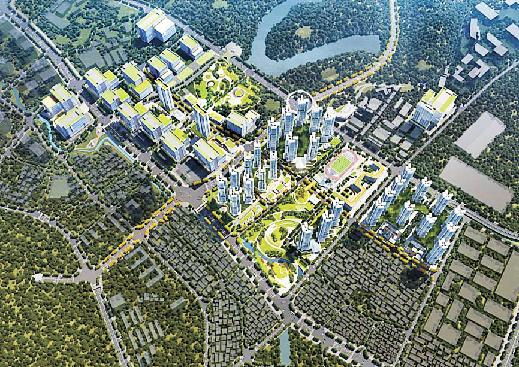
A computer-generated rendering shows the planned layout of a medical device industrial cluster in Longhua District. Photos by Bao'an Daily
The development comes as Longhua’s medical device industry continues to grow rapidly. In 2025, the district’s high-end medical device sector generated output of about 30 billion yuan (US$4.1 billion), with average annual growth exceeding 18% over the past four years — more than twice the citywide pace. Industrial value-added rose 20.8% year on year, making the sector a key contributor to local economic growth.
Longhua has positioned itself as one of Shenzhen’s main manufacturing bases for high-end medical devices and a key part of the city’s broader industrial cluster strategy. In recent years, the district has built an ecosystem that spans the full value chain, from early-stage innovation and testing to large-scale production and clinical use.
That ecosystem is reflected in a growing concentration of companies. The district is home to 93 major medical device firms and 67 specialized and innovation-driven enterprises, including 10 nationally recognized “little giant” companies and four national manufacturing champion enterprises. Innovative products are also increasing, accounting for roughly a quarter of Shenzhen’s approved medical device innovations.
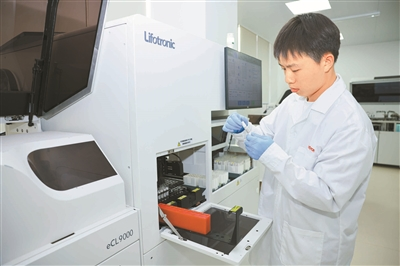
A technician conducts sample testing at a laboratory of Lifotronic Technology in Longhua.
Several companies illustrate the sector’s trajectory. Lifotronic Technology, based in Guanhu, has expanded its global presence in in-vitro diagnostics, with core technologies receiving international certification. Cornerstone Robotics, located in Guanlan, has obtained regulatory approval for its first-generation laparoscopic surgical robot and is seeking global certification.
In cardiovascular care, Shenzhen-based Insight Lifetech has gained a foothold in intravascular ultrasound and fractional flow reserve technologies, and went public in 2025 under Shanghai’s STAR Market listing framework. SiBionics, also based in Longhua, focuses on continuous glucose monitoring systems and AI-powered retinal imaging, with both product lines approved under China’s innovation pathway for medical devices.

A researcher works in a cleanroom at SiBionics in Shenzhen, a developer of continuous glucose monitoring technologies.
Policy support has been a key driver of this growth. In 2024, Longhua introduced Shenzhen’s first district-level policy package dedicated to high-end medical devices, covering research, manufacturing, financing and talent development. The measures include financial incentives for product approvals and clinical trials, subsidies for capacity expansion, and support for companies securing venture investment.
The district has also worked to improve financing and accelerate product development. Tailored lending and insurance solutions have been introduced for the sector, while partnerships with regulatory and testing institutions have helped streamline approval processes and shorten time to market for innovative devices.
A key part of the ecosystem is the National Innovation Center for Advanced Medical Devices, which has undertaken more than 120 research projects and secured over 140 patents. The center has incubated nearly 60 companies with a combined valuation exceeding 20 billion yuan, and has contributed to breakthroughs in areas such as high-end imaging equipment and life-support systems.
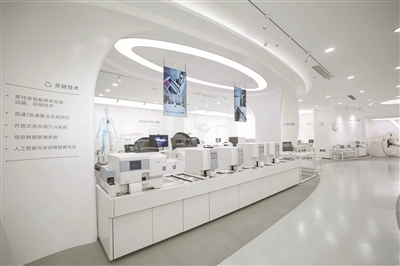
Medical devices are displayed at the National Innovation Center for Advanced Medical Devices in Shenzhen.
Longhua is also leveraging its healthcare resources to support real-world application. The district has seven public hospitals and an extensive network of community health centers, providing clinical scenarios for new technologies, including AI-assisted diagnostics, smart rehabilitation and telemedicine.
As construction progresses, the project is expected to anchor further industry growth by bringing together leading companies and innovation platforms. Plans include manufacturing facilities, research centers and contract development and manufacturing (CDMO) services.
According to the city’s development plan, the area is expected to host more than 500 key enterprises by 2035 and generate output of 150 billion yuan, forming one of China’s largest high-end medical device industry clusters.
Without written authorization from Longhua District People's Government,the content of the site shall not be republished or used in any form
Technical support hotline: 0755-23332038






